Thanks to Samurai Gamers for the images, especially the Antaris Battlefield Map.
This is a supplementary blog for sidequests that was mentioned on my Tower Defense guide.
This is by no means a definitive guide for roaming. I just wrote about some things to consider when planning on doing so. Another thing, this is for laners and not dedicated roamers or supports whose [MAIN QUEST] is not to clear lanes. If you want a support guide, I’d recommend following ALG Rest.
I’ve mentioned in the Tower Defense blog that as a laner, your [MAIN QUEST] is to clear waves and protect your tower. Once completed, it’s time to do some sidequests.
“Yay! Sounds fun! Gimme some sidequests right now!”
Okay, first, you have to look at the minimap.
“Uhm, that’s no fun. Imma go back pwning noobs. GG, stay thirsty, scrub!”
RADAR
The minimap is the most important yet most often ignored part of the HUD. I can’t comprehend why people can read and even respond to chat but don’t bother to look at the map. It gives a lot of vital information on what’s happening around. Try playing Diablo 2 and explore the entirety of Kurast without a minimap and see what happens. I remember a friend once playing Metal Gear (Snakeeater IIRC) for the first time. He used the hardest setting which doesn’t have a minimap. He died in the first few minutes of the game, mistaking an alligator for driftwood. On every game that has a minimap, it is a valuable resource. AoV is no different.
The minimap shows all allied units and structures and also the neutral jungle creeps. This will also show all enemy and neutral jungle creeps within your allied unit and structures’ field of vision. It’s easier to spot opponents on the minimap since they will immediately be shown once they enter allied line of sight whereas when just focusing on the main screen, there is a chance that you might miss them. When moving around, I usually just focus on the map, like using a radar, and just check the main screen when there’s a “bleep”. Keeping track of opponents is more convenient on the minimap. This is particularly helpful if you are monitoring threats that you want to isolate from your carry. Some skills can also be easier to land when focused on the minimap (i.e., Superman’s flight mode skills – I kinda imagine that I’m piloting a missile).
Using the minimap, one can easily monitor towers and defend the ones which are compromised. Many times I’ve experienced games being won or lost just by sneaky pushes, which should not be the case if only one is properly observing map.
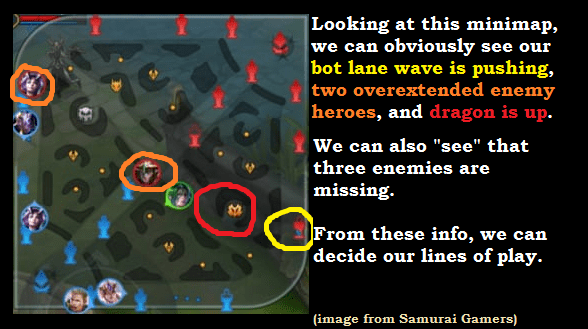
The minimap is a vital resource. It’s free and available anytime you look at the screen (which you’re doing always anyway) and I can’t think of any reason why you shouldn’t use it.
After clearing the wave and looking at the minimap, you might ask yourself, “so what’s next?”
SMALL CIRCLES, BIG CIRCLE
After looking at the minimap, imagine a circle around your turret that marks your safe area. Imagine an even bigger circle that encompasses your tower and the enemy tower, with the lane being the focal centerpoint. That would be the “soft roam” circle. This is an area where you’ll frequent when you “roam” or leave your lane.
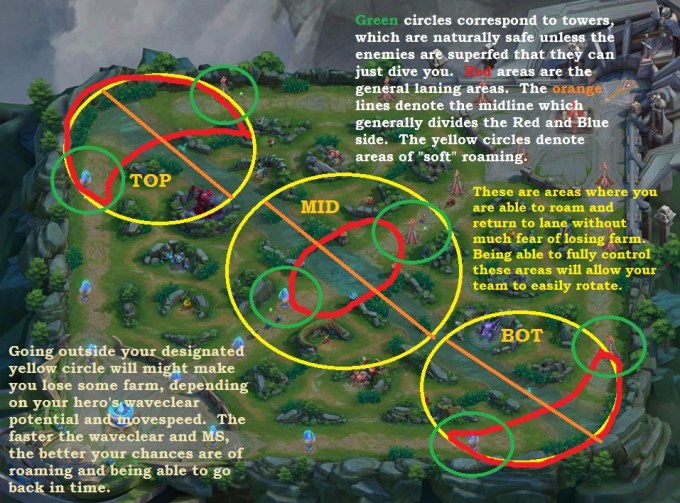
- The yellow circles on the diagram below indicate control areas where most actions take place, especially early game. “Soft roaming” is a term I use to describe moving inside these yellow circles. “Hard roaming” is going out of the yellow circle or even going inter-circle. All heroes can do soft roams, even immobile ones, but not all can do hard roams without losing lane farm.
When we think of sidequests, the first thing that would possibly come into mind is roaming. Roaming is simply leaving your designated lane in order to perform a task, i.e. helping a teammate or taking jungle creep, or simply providing vision. Sometimes you’re already roaming and you’re not even aware of it.
What is a successful roam?
Contrary to popular belief, roaming doesn’t always equate to ganking. Even obtaining a vital information in the map constitutes a good roam. Being able to pinpoint the enemy jungler’s location, especially in AoV where there are no wards, opens up a lot of tactical possibilities.
Can all heroes roam?
Technically, all heroes can but not all should. Good roamers are mobile and have fast waveclears. This would enable them to accomplish the [MAIN MISSION] and then go for available sidequests around the map. This is the reason why control mages aren’t that popular compared to assassin mages even though they have fast clears and better cc for potential ganks. Mobility is far too important to minimize the chances of losing farm. It also reduces the risk of being ambushed while on the way to an objective.
Soft Roaming
This is the type of roaming that all heroes can do since you’re just staying within the proximity of the lane. As said above, most of the time, you’ve always been doing this without even realizing it.
To easily grasp the concept, imagine you’re in a gang and you were given a small area (green circle/turret) as a hideout. Your goal is to control a part of a town (big yellow circle) as your own turf. Unfortunately, you’re sharing the area with a rival gang who also wants the area too, so for now you’re settling with half but eventually you want to have all of it. Of course, you want no enemy in your half so you’ll always keep it clear of intruders. Also, you’ll never let anyone in the rival gang mess with anyone in your gang Not in your house. There are small businesses too (neutral jungle creeps) within the vicinity. Will you let a rival gang get into them first? Of course not (most especially the seagles on the sidelanes which not only gives gold and exp but also vision of the opposing jungle).
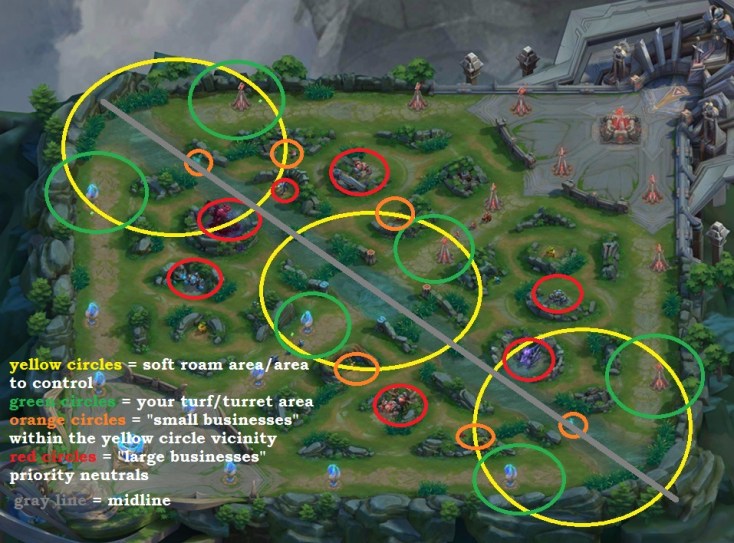
From the above description, this is your to-do list to maintain your turf and get control of the block:
- Protect your tower [MAIN GOAL]
- Take down enemy turf [MAIN GOAL]
- Clear creep waves [MAIN GOAL]
- Help allies in danger (sidequest)
- Secure neutral creeps/jungle (sidequest)
Your #1 goal is still to protect your tower since losing this will make you lose your “command center” thus automatically losing control of the yellow circle. Helping allies too is of utmost priority in soft roams. Unless you risk losing your tower in the process, it’s understandable to stop clearing waves in order to save a teammate since you can return to them immediately anyway.
What about the rival gangleader?
Any competent gangleader will never let his rival get even a foothold of his territory. Eventually, rivals will need to be eliminated for you to accomplish your goal of securing the turf since they’re most probably in your way. Then, why isn’t assassinating a rival leader included in the list of important stuff?
Because it’s just a means to an end. Not The Goal. Just an inconvenience. That’s why, you should only force an enemy hero kill if he/she is preventing you from doing your checklist. Are the enemy heroes preventing your siege? Take em down. Are they trying to steal the buffs/dragon/slayer from you? Take em down. Are they in the range of threatening your turrets? Take em down. Are they in the process of killing your allies? Take em down. But after taking them down, you’ll go back to the task at hand. Remember that your goal for killing is not the kill itself but the objectives. So, don’t chase kills. Just don’t. It really irks me that people run halfway across the map for kills but can’t do the same for their turrets. Never ever trade your turret for a kill. Doing so means sacrificing your primary objective to a thing not even on the list.
Before going for a kill, ask yourself first what can we get after killing the enemy? You should be able to take advantage of the situation and get something, after all you’re using resources to take something down.
…and is the risk worth the reward? As already mentioned, make sure that the reward for killing is worth the amount of your expenditures. If you needed to burn 3 ultimates and 3 talents in order to kill 1 enemy hero and lost a teammate in the process only to get a small creep, you’re doing something wrong. Worst even is burning the same amount with no return of investment. If you’re thinking of the hero kill bounty, remember that killing a hero also raises your bounty as well. So if you got a huge bounty on your head by killing heroes and didn’t get objectives in the process and then got shutdown in the end, you’ve just given gold to the enemy and had no return of investment.
Again, you’ll have to look at the minimap to assess for better risk assessment as there might be enemy heroes converging towards your direction.
Mastery of soft roaming gives your team control of a designated territory. Unless risking giving a double kill to the enemy, ALWAYS prioritize helping a teammate in danger within your yellow circle, even over farm. Remember that letting the enemy get kills will get them ahead of you, not only in gold but in levels as well, which will make it hard for you to contest for objectives.
Let’s say you’ve cleared the lane, the enemy laner is recuperating after the savage beating that he received from you, and you look at your circle and there’s nothing else to do. Your waves are far, far off from the midline and you want to kill time.
The Hard Roam
If you feel you’ve grown too large for your pond, it’s time to look elsewhere for bigger prey. Hardroaming gives you access to the red circles (large neutrals, including golems, dragon/s, and slayer) around the map. You can also go to your other team circles to provide assistance. When doing a hardroam, be sure to clear your lanes and check for incoming waves. You can then estimate if you can perform a roam outside of your yellow circle and make it back in time for the waves. Always remember to make it back in time as it’s often not worth it to lose control of the yellow circle just for a hard roam. As a gangster, you also have to be a good businessman and always look for the best return of investments.
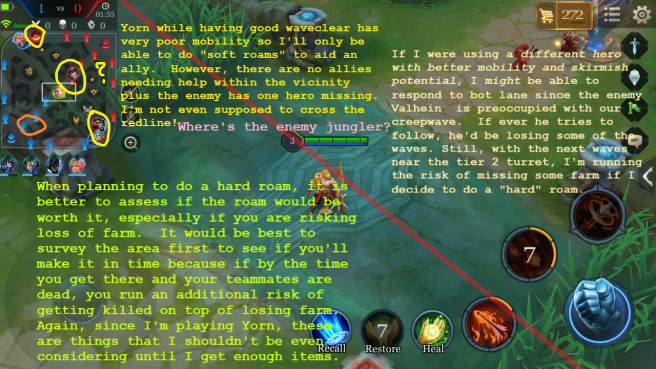
Before doing a hardroam, ask yourself first “am I capable?”; second would be “what is my aim?” third is “would I make it in time? ” and again, last would be “is it worth the risk?”
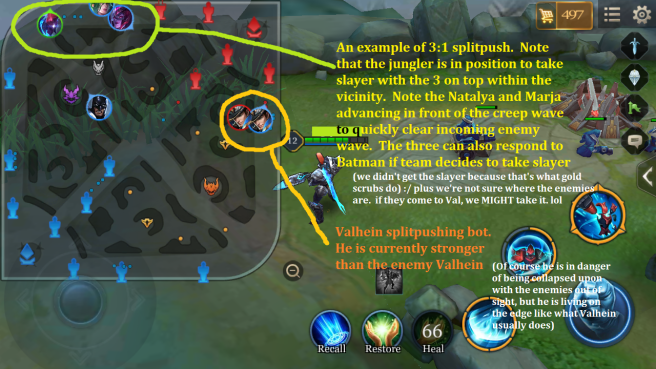
Using the above screencap, we can say that Yorn is not really capable of doing a hard roam. He has nothing much to offer except for giving numbers advntage to the team. With his poor mobility, it’s uncertain that he can make it in time to help (might make it for a cleanup). Overall, it’s just too risky for him to go, especially with the enemy jungler missing. He might end up getting ambushed on the way and with the enemy Valhein in mid, things can easily go bad if Yorn gets caught. If Yorn in the above scenario is replaced by let’s say Arthur, he might even be able to do a quick hard roam without having to lose much in the process.
Ganking
Ganking is simply defined as flanking an enemy to gang up on him (gang-flank, hence gank). This is probably the most popular roaming objective as when a laner roams, it’s usually to gank other lanes. It’s almost a rule of thumb to do this on overextended enemy laners to relieve pressure from that lane or to help open up more options in the map. For example, if dragon is up, you can gank the nearby enemy laner so they won’t be able to contest your target objective. If the objective is a tower, you can perform a “tower dive” or ganking an enemy under his/her turret and then try to take tower afterwards.
What is a successful gank?
A gank can already be considered successful if you are able to relieve pressure from a teammate without losing much resources (no deaths, no missed waves). A perfect gank is when you’re able to take down the target hero and secure whatever goal you had in mind. If you’re doing a saving gank (goal is to relieve pressure/save turret), then you don’t necessarily need to be able to take a turret or a jungle monster. If you’re not able to make it in time to save a teammate or a turret, you can still of course kill the enemy hero for a retaliation gank. It’s more of cutting off some of the losses instead of gaining an advantage. A saving/retaliation gank can be turned into an advantage though if there are options open within the area. After a successful gank, always check the minimap for objectives that you can take afterwards.
Sometimes you won’t be able to get a takedown on a gank. If a target escapes and will take a lot of effort to chase down, just let it escape and again, look for the minimap for any salvageable objectives. Don’t chase kills especially into a fog of war. Focus on more easily achievable objectives. Would you give up your dreams for a girl that is not even remotely interested in you? That’s what you’re doing if you are chasing kills.
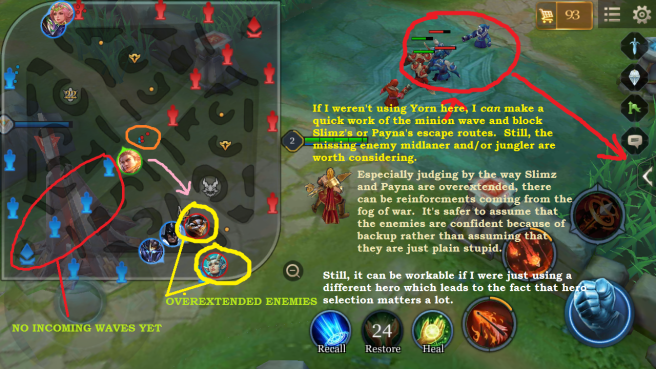
Let’s say your target escape and you weren’t able to take any objective from the map, is the gank a fail? It’s hard to say actually. The best part of a gank in my opinion is not the kill itself but the psychological effect that it gives to your opponent. It’s just like sending a message that you’re watching him/her. Still, surviving repeated ganks may send a message to the target that “you’re not strong enough” and might make them brute force their way if that’s really the case. I could say a gank is a failure if you weren’t able to acquire anything then lost something in the process, like waves, turret, or even an ally.
Some tips on ganking (these are actually no-brainers but I’ve seen players still making these mistakes)
- Don’t gank when there’s a creep wave crashing on your turret. Your teammate might not even be ready to help you if you’d proceed. But get ready to immediately enter the fight if the enemy decides to dive your teammate and be sure that the enemy has tower aggro.
- Don’t forget to look at the map and survey the area.
- Don’t gank if the enemy is in an advantageous position, unless you’re doing a saving gank. If doing so, don’t try to force a kill. Your aim is to save a teammate so disengage is your primary goal here.
- Don’t be hasty. Wait for the enemy to be in fight mode.
- Don’t run directly to your target. Try to cut its escape route instead.
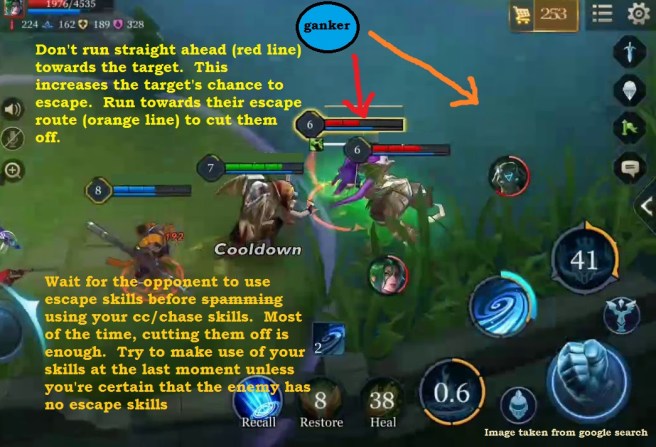
For gank receivers, it’s usually your responsibility to start the gank. Yes. Not the ganker. You. You are responsible for making your opponent “commit” to the fight. If the opponent is not committed, he/she can easily escape. It is your duty to make the opponent enter “fight mode.” Most of the time, I see laners spamming attack ping to gankers while they are too far to respond. Remember, the ganker is doing you a favor. Don’t be an entitled prick.
Control mages arguably would be the deadliest gankers. Unfortunately, they are severely burdened by their lack of mobility that just leaving their soft roam spots will put them in a risk. They are the best gank receivers though. They can also perform fake ganks to unwary opposing laners.
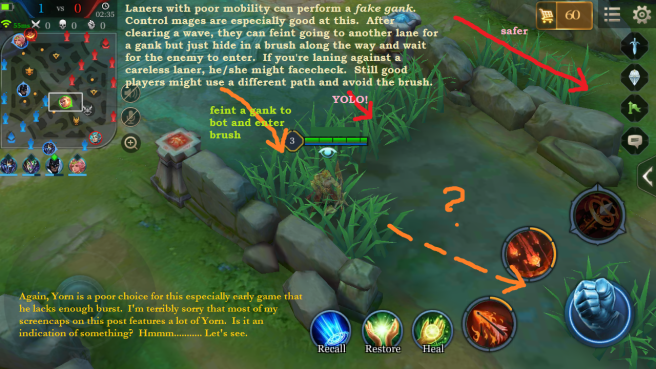
Again, as I’ve stressed for the umpteenth time, ganking as it’s simply killing an opponent, should have a game-changing goal in mind. It’s merely a means of getting an advantage against your opponent. Mindless ganking usually just leads to a team deathmatch which is not the victory condition.
CONCLUSION
Sidequests are means of obtaining an advantage over your opponents, be it buffs, gold, or plain terrain. Focusing on towers is still the victory condition of the game. Still, it’s best to maximize all the resources in the map as they can help to ease the burden of forcing towers. Again, as I’ve already mentioned, this post is not a definitive guide for roaming or ganking, just some insights from a scrub. It’s best to watch and observe pro games in order to get a better grasp of the subject.
I hope you gained something from this. As with my other post, I enjoyed making this too. Again, see ya in the Antaris Fields. Observe. Formulate. Adapt.
Please Like and Follow my Facebook page. Thanks for your support!
 The Omniscientist